This guest blog by Laura Miller, a student researcher at Cuesta College, highlights genetic research investigating the slime mold linked to eelgrass wasting disease.
Eelgrass is a vital part of the Morro Bay estuary and the diverse plant and animal species that call it their home. The health of this flowering plant is impacted by many factors, including water quality and bay elevation. Eelgrass acreage in Morro Bay has fluctuated widely over the past two decades, declining from 344 acres in 2007 to 13 acres in 2017 and then recovering to 750 acres in 2023.
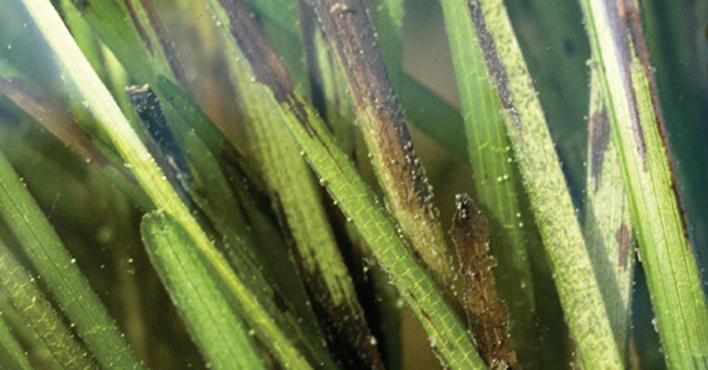
Throughout times of eelgrass abundance and decline, a slime mold that causes eelgrass wasting disease (EWD) has been present in Morro Bay. While EWD can be devastating, such as during the 1930s when it virtually eliminated eelgrass in the North Atlantic, its presence does not necessarily indicate a death knell for eelgrass.
Studying Slime Mold in the Morro Bay Estuary
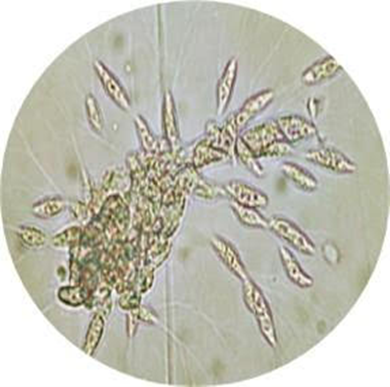
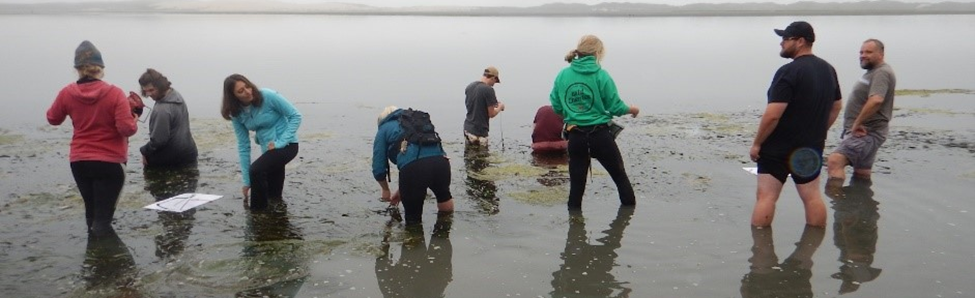
Across the globe, seagrasses have been experiencing a decreasing trend. One potential cause of these declines is the slime mold Labyrinthula zosterae, which plays an important role in EWD. Although Morro Bay currently supports an abundance of eelgrass, EWD is known to inhabit Morro Bay. Researchers at Cuesta College and their collaborators have been investigating the genetic diversity of this slime mold to understand why some eelgrass meadows experience more severe disease outbreaks than others. Cuesta also offers a summer course in which students collect eelgrass, monitor slime mold growth, and isolate the slime mold DNA to develop a greater understanding of how EWD infects eelgrass and adapts to environmental stressors.
The Importance of DNA Isolation
Isolating the slime mold’s DNA is a critical piece of the puzzle for this research. When blades of eelgrass are collected during low tide, there is a lot of genetic material that exists on the blade, whether that’s from the eelgrass itself, or from other organisms living in the estuary. To isolate the slime mold DNA, the eelgrass blades must be processed in the lab. The blades are dehydrated, ground into a powder, and then processed with a series of buffers and filtrations that isolate slime mold DNA from impurities. The concentration and purity of DNA are then measured to determine whether the sample can be used for further analysis by means of either polymerase chain reaction (PCR) or Random Amplified Polymorphic DNA (RAPD).
These processes allow for reliable genetic analysis from small segments of DNA by making lots of copies of the segments. This effectively amplifies the amount of DNA that was found in the samples, making it possible to sequence them and see trends in genetic variability. Without isolating the slime mold DNA from the rest of the DNA on the eelgrass, there would be no way of accurately interpreting the results and studying their genetic diversity.
DNA Isolation Timeline
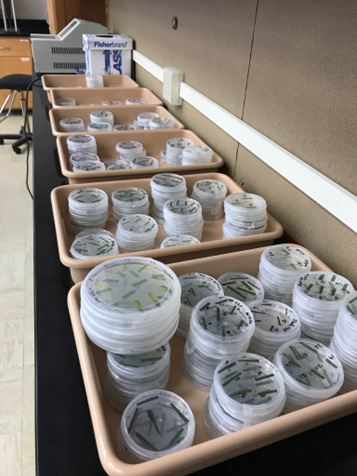
Once the blades of eelgrass have been processed, the samples can be frozen for an extended period of time before they are treated, filtered, and analyzed. This allows students over multiple years to collect eelgrass to visualize trends in the DNA across time, such as periods when EWD symptoms were the most prominent, and across sites from different parts of the estuary. Having a larger data set means having more information about the role of slime mold in EWD and how we might protect vulnerable eelgrass populations.
What Comes Next
At the beginning of this project, the goal was to discover if the slime mold was present in Morro Bay and if it grew on both healthy and diseased blades. Preliminary analysis of blades from 2018 to 2020 showed that it can be found throughout the estuary and grows on both healthy and diseased eelgrass tissue. Results also showed notable genetic variation in slime mold growing in the front bay versus the back bay. Our current data set contains DNA isolated from slime mold on eelgrass from 2021 through 2025. All the isolated DNA is currently being used to generate PCR and RAPD results.
The comparison of slime mold isolates between healthy and diseased blades can help us better understand whether the slime mold is actively causing the spread of disease to healthy blades or if it is an opportunistic pathogen preying on blades in an already weakened state. In addition to providing answers to our lingering questions about eelgrass wasting disease, this long-term Cuesta College project also provides an opportunity for undergraduate research for students such as myself to prepare for their academic futures. The project will continue this summer, with more students collecting data and isolating samples for upcoming analyses. Results of the genetic analysis are expected later this summer.
Author Bio
Laura Miller is a student at Cuesta College, pursuing degrees in both biology and chemistry. She has been involved in genetic isolation research since August 2025, under the guidance of Drs. Silvio Favoreto and Laurie McConnico. Her interest in DNA and molecular biology stemmed from taking the eelgrass research summer course in 2025, which opened the door to continue further undergraduate research at Cuesta. Laura is currently applying for master’s programs in Biochemistry and hopes to use all she has learned from this project to continue research in the intersection of chemistry, biology, and ecology in her graduate studies. When she is not in the lab, Laura loves hiking, camping, line dancing, and spending time with her pug, Molly.

References
Polymerase Chain Reaction (PCR) Fact Sheet. NIH National Human Genome Research Institute. https://www.genome.gov/about-genomics/fact-sheets/Polymerase-Chain-Reaction-Fact-Sheet
Random Amplified Polymorphic DNA (RAPD). NIH National Center for Biotechnology Information. https://www.ncbi.nlm.nih.gov/probe/docs/techrapd/
Short, F. T., Muehlstein, L. K., Porter, D. 1987. Eelgrass Wasting Disease: Cause and Recurrence of a Marine Epidemic. The Biological Bulletin (173). https://www.journals.uchicago.edu/doi/10.2307/1541701
Waycott, M., Duarte, C. M., Carruthers, T. J. B., Orth, R. J., Dennison, W. C. Olyarnik, S., Calladine, A., Fourqurean, J. W., Heck, K. L., Hughes, A. R., Kendrick, G. A., Kenworthy, W. J., Short, F. T., Williams, S. L. 2009. Accelerating loss of seagrasses across the globe threatens coastal ecosystems. PNAS (106). https://doi.org/10.1073/pnas.0905620106